Caves
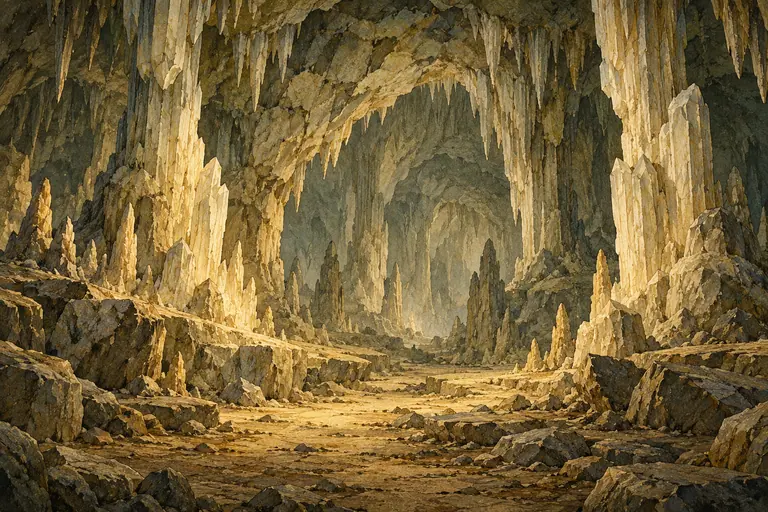
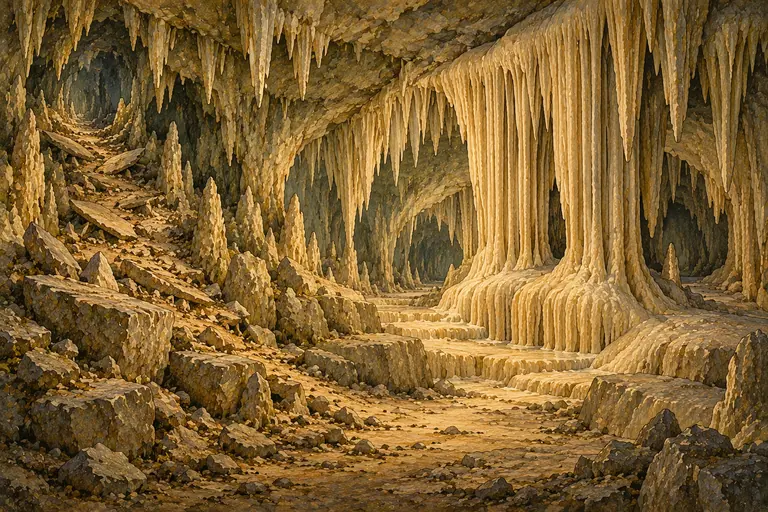
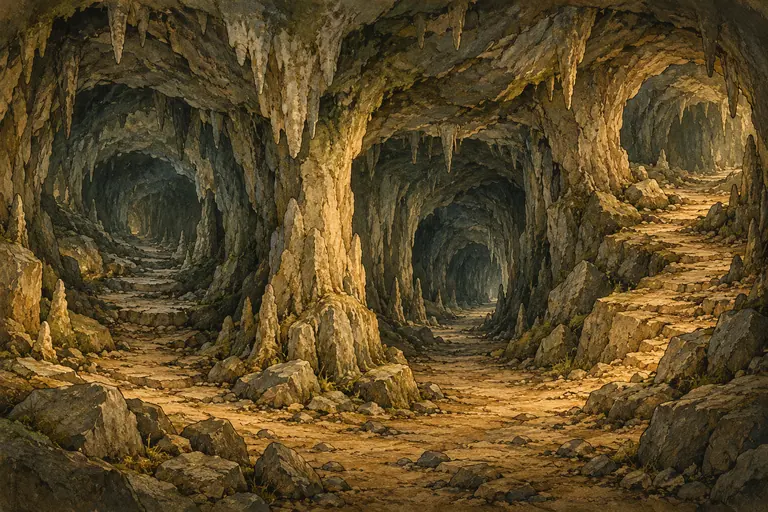
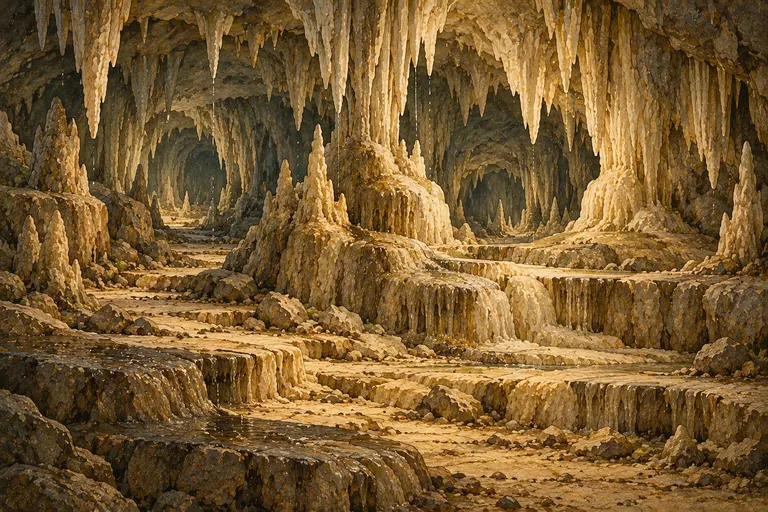
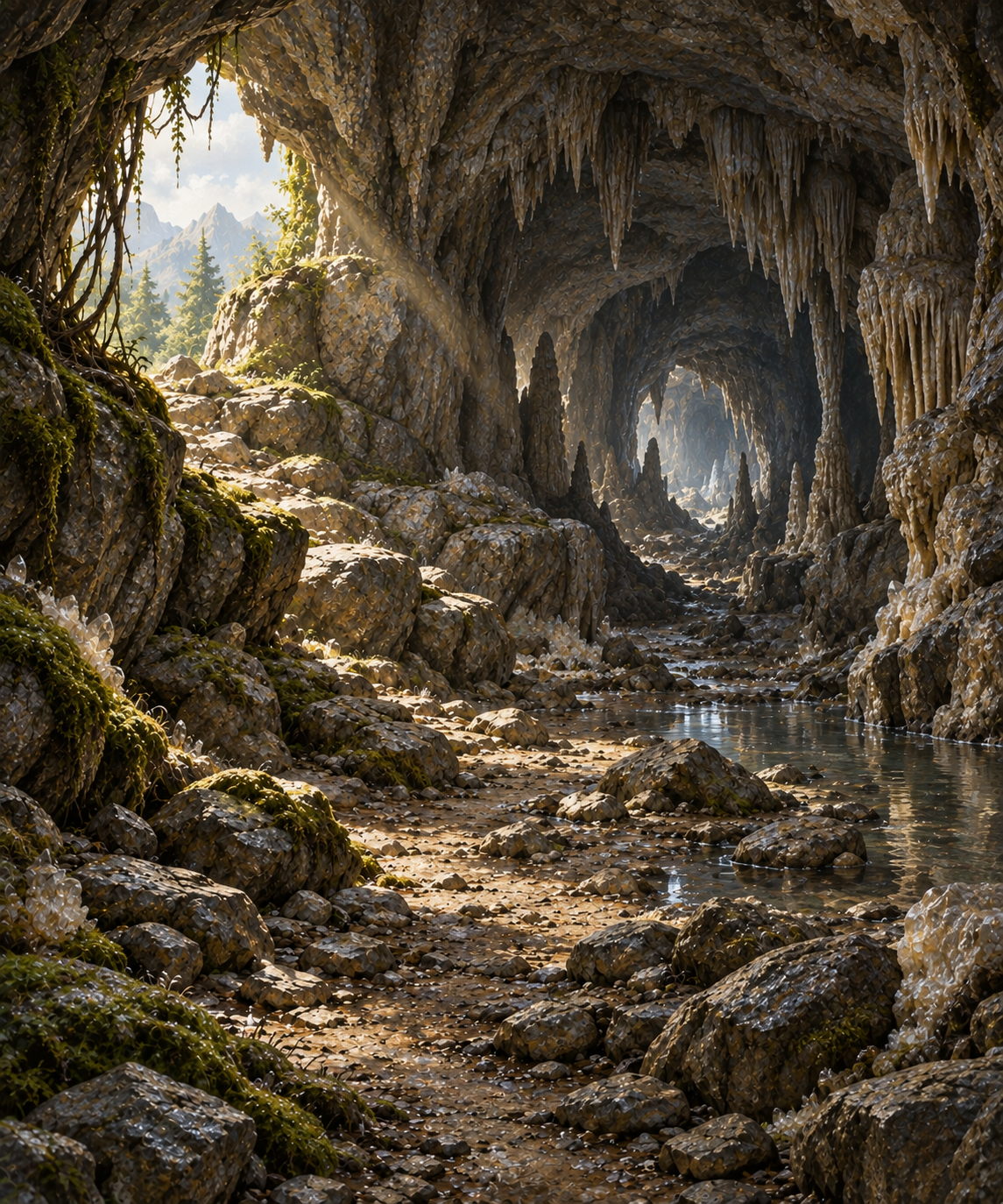
Caves are self-contained underground expeditions. Every entrance leads to a hand-built cave with its own variant, story, hazards, mineral faces and finite loot. Inside, light is your clock: each unit of light buys one minute underground.
See also Health, Injuries and Collections & Museum.
Finding a cave
- Explore Cave action: finds an entrance 15% of the time on mountain tiles and 5% elsewhere.
- Cave rumours: traders sell rumours that point to entrances you haven't finished.
- Each entrance keeps its identity for the whole run: the same variant, layout and remaining contents every time you come back.
Cave variants
| Variant | Where it can appear | Final chamber |
|---|---|---|
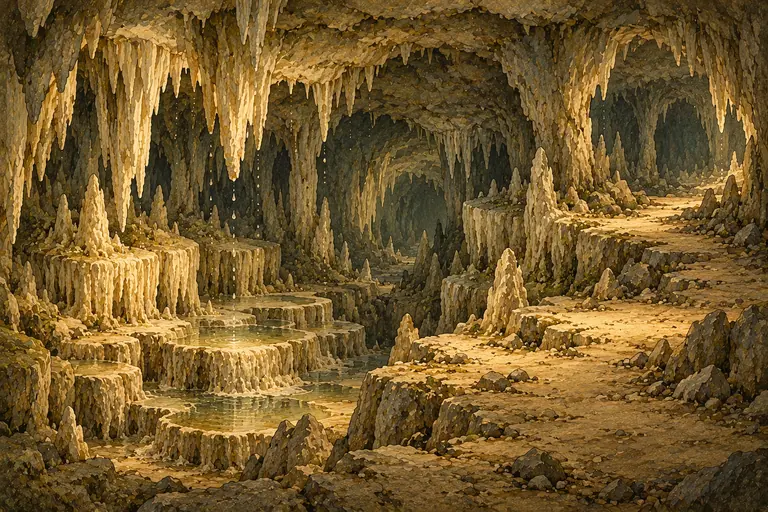
| Dripstone Caverns | Anywhere | Cathedral of Stone |
| Abandoned Mine Workings | Anywhere | Last Working |
| Fossil Caverns | Limestone / sedimentary ground | Ancient Reef Wall |
| Underground River | Near water | Hidden River Hall |
| Fractured Granite | Mountains | Great Fracture |
| Root & Fungal Hollows | Forests | Rootfall Chamber |
| Icebound Cave | Cold conditions | Blue Vault |
| Lava Tubes | Rare volcanic regions | Last Skylight |
Each variant's run conditions, signature chambers and investigation story are on Cave Variants.
Cave layout
- Size: 12–24 chambers, with loops, so there's often more than one way back.
- Chamber types:
| Chamber | Purpose |
|---|---|
| Entrance | Start and exit |
| Evidence | Clues for the cave's story |
| Signature | The variant's showpiece rooms |
| Quiet | Safe pauses |
| Mineral | A mineral face for mining |
| Objective | The final chamber |
- Support rooms: long caves add rest shelves, squeezes and small caches near the end.
- Run conditions: each visit rolls one of the variant's 3 conditions (for example rising flow or strained timber). The same condition never repeats twice in a row.
- Environment events: 1–3 interactive and 1–2 observable events per cave. If you ignore an interactive event for 12 minutes, nearby passages get +2 minutes slower.
- Fixed on entry: the layout locks when you first enter. Loot and finds don't respawn.
Light and time
- 1 light = 1 minute of cave work or travel.
- Light sources: torch, candles, flares, flashlight, lantern, headlamp.
- Headlamp: holds 20 charges (800 minutes). One Battery Cell recharges +10 charges.
- Travel time between chambers: the passage's minutes + slope, adjusted by:
| Modifier | Effect |
|---|---|
| Route secured (rope, footholds) | Half time |
| Route project built | −2 minutes |
| Unanswered environment event nearby | +2 minutes |
| Leg injuries, exhaustion, heavy pack | Slower |
- Running out of light: only an emergency return is left, at double time and effort.
- Fatigue and the clock: every cave minute costs 0.12 fatigue and moves the normal game clock forward.
- Survival inside: you can eat, drink, treat wounds and rest in a cave, but these also burn light.
Chamber actions
| Action | Time | Effect |
|---|---|---|
| Observe | 3 min | Records evidence for the cave story |
| Secure route | 5 min | Makes the passage faster from now on |
| Bypass | 8 min | Safe way around an obstacle |
| Respond to event | varies | Clears its delay or reveals a recovery lead |
| Record objective | varies | Completes the cave |
Most actions play out as short minigames. The time is charged when you start, and the reward comes when you finish.
Minigame steps
Each cave task is a sequence of one or more steps:
| Step | What you do |
|---|---|
| Trace | Draw along a marked line (a rope route, a water channel, a trail) from the first marker to the last. Leaving the safe line restarts the step |
| Drag | Pick up pieces (sketch fragments, lids, cloth folds) and drop them in their places. Some must be rotated so the notch faces the right way |
| Turn | Grip a handle and turn it gradually (a compass sketch, a catch, a vane) to the target angle |
| Pressure | Hold a marker inside a moving band until the bar fills (loading a knot, testing a flake) |
| Inspect | Move the lens over each spot and hold briefly to read it |
| Steady | Like pressure, but you must also wait out the moments when an animal stirs |
| Stealth | Trace a line, but only move during quiet moments. Moving while the animal stirs restarts the step |
- Mistakes: they're counted and may affect the outcome.
- Touch screens: you get a wider tolerance.
- Assisted mode: gives the widest tolerance.
- Variety: each puzzle is mirrored and shifted slightly by the cave's seed, so the same task never looks exactly the same.
SLAM scanner
- What it does: a rare laser survey instrument (3 kg, value 750). While you carry it, the cave map gets a rotatable 3D view.
- Controls: drag to rotate, right-drag to pan.
- Light: viewing the map costs no light.
- Where to get it: traders have a 5% chance to stock one (checked every 72 hours). The Mountaineer loadout starts with one.
Hazards
Hazard families: exposed ledge, active water channel, loose rock, occupied den, sharp restraint, awkward find. How you approach one:- Inspect (free): see what you're dealing with.
- Prepare (2 minutes): lowers the incident risk.
- Choose your approach:
- Safe: slower (+2 minutes), no incident possible.
- Risky: ×0.65 time. The incident chance is 8% if you prepared, 22% if not, and higher when you're exhausted or overloaded.
| Incident | Result |
|---|---|
| Ledge | Fatal fall |
| Loose rock | Head hit (≈30 damage) + bleeding |
| Water | Immersion: 3 breaths to reach the lip; you can cut loose a snagged item |
| Den | Bite, then escape by covering or backing off |
| Sharp | Hand cut |
| Awkward find | Arm fracture |
- Protection: a helmet and gloves reduce injury severity by 35%.
- Equipment loss: some incidents can make you permanently lose carried equipment.
Mining and minerals
- The mineral face: a 9×7 grid of rock cells. You work it with a pick, chisel or wedge.
- Stress: every stroke adds stress to the face. Long or badly aimed strokes add more. A brace/support kit cuts stress to ×0.4. At 100 stress the face collapses and closes.
- Picks vs chisels: a pick shatters crystals into fragments. Chiselling around a crystal recovers an intact specimen.
- Specimen value: 5–80, based on mass × purity × how intact it is.
- Rare inclusions: fossils, crystal pockets and hidden passages.
- Mining tools from traders: chisel 35, wedge 45, support kit 30 (value).
Selling and using minerals
- Mineral lots can't be bartered directly. Sell them to a settlement merchant for mineral credit. Credit covers shortfalls in later trades with that merchant.
- Verified cave reports and specimens can also be submitted for credit.
- Crafting: quartz grit and calcite chalk. Chalk lets you leave route marks in caves.
Finds and story
- Recovery reservoir: each entrance has 4 small supply bundles plus 2 finds revealed by working.
- Stash rarity: 72% common, 21% uncommon, 7% rare.
- Story: each variant tells an investigation story with 3 clue beats, a landmark you can name, and a conclusion.
- Rewards: completing caves gives exploration score (cave depths and full clears).
Subterranean Formations & Geological Variants
Caves provide absolute temperature stabilization during blizzard conditions, but carry hazards of rockfalls, darkness disorientation, and apex predators.